Abuse, neglect and trauma always take place in a social context. The impact of abuse is not limited to the person who has been abused. One prominent impact from the perspective of family systems is the limitation on available roles within the family or abusive system. You may be more familiar with the constraints on family roles which take place in families in which one member is addicted (hero, scapegoat, lost child, mascot etc.) ((See for example: Sharon Wegscheider, Another Chance: Hope and Health for the Alcoholic Family, Science and Behavior Books,1981.p 86)) The same kind of constriction happens in families in which one person has been abused — whether or not the abuser is part of the family.
A number of people have suggested that the roles available to members of families where abuse is a factor can be summarized by looking at three primary roles: victim, victimizer and rescuer. ((Karpman, Stephen, Overlapping Egograms, Transactional Analysis Journal 4:4 (Oct 1974) )) ((When Helping You Is Hurting Me by Carmen Renee Berry, Harper & Row, 1988)) ((Carnes, Patrick J. The Betrayal Bond, Health Communications, 1997)). None of these three roles is healthy. They are all best understood as part of the abusive system. My own preference is to think of abusive or neglectful family systems as involving four possible roles: victim, abuser, hero/messiah and non-protective person. One of the more important things to observe about the abusive system is the relative ease with which people within the system can change roles. Because each of these roles is part of the abusive system, they all are painful to experience. And so people often try to switch roles, hoping that one of the other roles will be less painful. Here are short descriptions of all available options–notice the obvious, they are all bad options:
Bad Options for a Victim
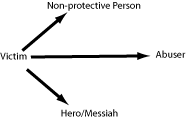
- A Victim can become a Non-Protective Person. Example: someone who was sexually abused by a father who finds themselves later in life unable to protect their children from their grandfather.
- A Victim can become an Abuser. Some people talk about this as an attempt to find a more powerful role. “I’m tired of being the victim. I need to be more powerful than that. I can fight back.” Others think of this as a kind of returning to the scene of the crime–returning to an abusive situation but in a more powerful role. This is what Sandra Wilson is getting at in her book “Hurt People Hurt People.” ((Hurt People Hurt People: Hope and Healing for Yourself & Your Relationships by Sandra Wilson, Discovery House Publishers, 2001))
- A Victim can become a Hero/Messiah. Example: someone who prematurely seeks to turn their own painful experiences into ministry to others. The focus on others can truncate the healing process. There’s nothing wrong with helping others but if it is a way to avoid doing my own recovery work, then the results are not pretty.
Bad Options for a Hero/Messiah
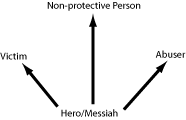
- A Hero/Messiah can become a victim. Example: I have worked myself to death rescuing victims and sometimes they don’t even appreciate all my sacrificial giving. In fact some of them resent me. I’m starting to feel like I’m the victim here.
- A Hero/Messiah can become a Non-Protective Person. I call this the ‘trajectory of the burnt out social worker’. Example: “I’ve been giving too much for too long and I’m just not able to care anymore. I’m resentful at people who have not appreciated my work. And I’ve learned my lesson . . . I’m not going to be a hero anymore. I can’t fix this and I’m not going to pretend that I can. I’ll do what I’m required to do but that’s it. I can’t protect everyone anyway. And a lot of them don’t even want to be protected.”
- A Hero/Messiah can become an Abuser. Think of a spouse of someone who was sexually abused as a child. When it first becomes apparent that abuse is part of their spouse’s story, they commit themselves to being the perfect spouse. “My spouse needs me now more than ever. I’m going to be really strong and really helpful and really good.” But over time you get tired. Hurtful things are said. You are getting hurt. . . and you need to defend yourself. The once strong, helpful, good person can eventually find themselves doing things which the Victim says are hurtful. Even if they do no actual harm. . . they have made the move from the hero/messiah role to the abuser role.
Bad Options for an Abuser
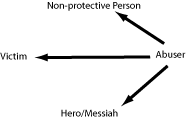
- An Abuser can become a Non-protective Person. When an abuser starts to feel threatened, they may try to find safety by distancing themselves from the whole situation. “This is not my problem. I can’t help you with this. I can’t protect you from whatever you think is going on.” When neither the hero role nor the victim role are available, this may become an attractive transition for someone who feels stuck in the abuser role.
- An Abuser can become a Victim. The most common response of abusers when their abuse becomes known is to argue that they are really the victim. People are accusing them falsely. People are hurting them by thinking such evil things. When the abuser role becomes painful it feels safer to compete for the victim role. If an abuser was abused earlier in life this sense of entitlement to the victim role can be particularly strong.
- An Abuser can become a Hero/Messiah. The classic example of this is domestic violence. Immediately after a violent episode the abuser will typically be full of remorse, will promise that it will never happen again and will be determined to be the best husband ever. None of this represents a move towards health. It is just a move from the abuser role to the hero/messiah role. It is a move within the system — not a step outside of the system.
Bad Options for a Non-Protective Person.
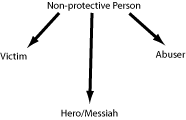
- A Non-Protective Person can become a Victim. Think here about a mother who was unable to protect her children from being sexually abused by their grandfather even though she knew they were at risk. The abusive system may seek to reassign this mother to the abuser role (see below) but this effort will be resisted by the non-protective parent who may argue that they are really the one who has been betrayed. They may insist that they are just as much a victim in this situation as the children. This may, of course, have some truth to it. But the move from non-protective person to victim does not represent any progress. Both roles are part of the abusive system.
- a Non-Protective Person can become a Hero/Messiah. Earlier I characterized the transition from Hero to Non-protective Person as the ‘trajectory of the burnt out social worker.’ A transition in the opposite direction is what can happen when a burnt out social worker (or pastor, or spouse or whatever) finds a way to recharge their batteries. They take a break, find some more energy and get right back into the battle. The experience of burn-out does not always lead to substantive change. We may just rest, recharge and plunge as soon as possible back into the same role which lead us to burn-out in the first place.
- a Non-Protective Person can become an Abuser. A person in the non-protective role is always at risk of being reassigned to the abuser role. “If you didn’t stop it, you are just as responsible. If you didn’t know, you should have known.” Note that a person does not need to act abusively to be assigned to the abuser role. These are roles — the system rarely feels an obligation to be fair when role assignments are made.
There are three main reasons for taking the time to focus on roles in abusive systems.
First, it is important to emphasize again that all of these roles are grace-less, hurt-full roles. None of them provide people what they really need and long for — to love and be loved. But they are very powerful roles as well. Once in an abusive system it will take significant effort to imagine other ways of being in the world.
Second, it is important to say the obvious: changing roles has very little to do with healing. Changing roles is a classic rearranging the deck chairs on the Titanic kind of thing. Moving to a different role may seem to provide some respite from the pain of our current role, but the respite is temporary at best. Any healing will require finding a way to get ‘outside of the box’ of abusive systems. That presents an obvious problem: when you are inside the box, the inside of the box is all you can see. It may be literally unimaginable that things could be different. That is why recovery is not something we can do by ourselves. We just can’t see what we need to see. We need other people to help us.
Finally, if you are a pastor or other person in a caring role, you will be invited to participate in systems of this kind — typically the invitation will come as a recruitment for the vacant position of hero-messiah. If this seems like a wonderful invitation to you — like an invitation that is a good match for your gifts and interests — then you will be in significant danger of becoming part of the abusive system. And once part of the system you will find it extremely difficult to be helpful. Even if you are aware of your limitations and conscious of the dangers of becoming part of abusive systems, people inside the system will experience you as if you were part of the system. And, if you are not really, really good at the hero-messiah role you may find that you are at risk of being reassigned to a different role within the system. Finding a way to speak truth and offer hope in the context of abusive systems without becoming enmeshed in the abusive dynamics is not easy. Possible. But never easy.
